How to Handle Insults and Ridicule—Part One
Ministries > Pastor Rick's Daily Hope with Pastor Rick Warren

The book of Nehemiah is a great example of how God works with you to accomplish his plans and purposes for your life. In this series, Pastor Rick teaches you how to trust God to work through what’s beyond your control while planning for what you can control.
One of the biggest ways God tests your character is through how you respond to critics. Using examples from Nehemiah’s life, Pastor Rick describes five ways people will try to stop you with insults and ridicule and five biblical responses to opposition.
Life is full of God-given opportunities. But with every opportunity, there will always be opposition. How do you respond to that kind of criticism? Join Pastor Rick as he looks to the Bible for an answer to that question.
References
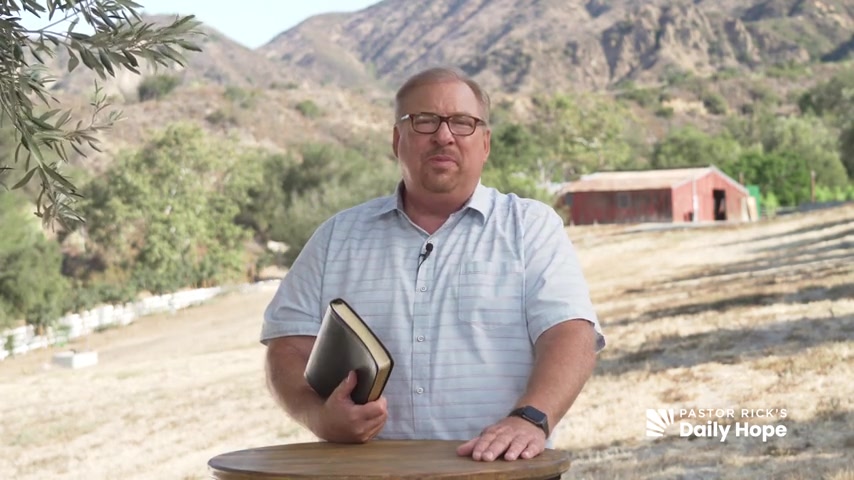
Announcer: Hey everybody, thanks for spending some time with us at Pastor Rick's Daily Hope. We are so glad you're here. You know, no matter where you are in life or what you're facing today, God has a purpose and plan for your life. Today we continue our series called Building a Better Future. In this series, Rick Warren explores the lives of biblical leaders who rebuilt after seasons of hardship and captivity. You'll discover practical, biblical principles to help you move forward with hope and confidence as you trust God's plan for your life. And now here's Rick with part one of a message called How to Handle Insults and Ridicule.
Rick Warren: This week we continue our study in building a better future, and we're learning from the greatest builder in the Bible, a man named Nehemiah. there will be people who don't understand what you're trying to do and what you're attempting to do or how you expect to do it in building a better future. But even if they do understand it, there will be many people who will oppose you, and that's what we're going to look at this week. I've often said there is no opportunity without opposition. There's no opportunity without opposition. In fact, here's a little equation. Opportunity plus opposition equals God's will. Opposition is actually part of God's will in your life. Now, I could describe my past 41 half years as your pastor, in the same way Paul says it, in 1 Corinthians chapter 16, verse 9. He says it like this, "There is a great opportunity here for an effective work, even though there is also much opposition." Those two things, opportunity and opposition, go together. And if you're gonna build a better future, if you're gonna make something of your life, not everybody's gonna like it, not everybody's gonna agree with it. And in the same way, whatever your dream is, whatever your goal is, whatever your ministry objective is that you have, whatever vision you have for the future, for building a better life and building a better future, you can expect different kinds of opposition. Nothing is easy in this life. Now, one of the greatest tests of character is going to be how you handle opposition in life, and God is watching your response. Do you panic under pressure? Do you become discouraged and quickly give up when anybody expresses anything that they don't like your goal or they look at you the wrong way? Have you quit on your God-given dream simply because somebody disapproved of it or somebody criticized it or heaven forbid somebody made fun of it? You know, I think one of the largest groups in the world today is the International Bucket Committee, and these are the people who feel it's their responsibility and duty to toss cold water on every dream or idea or project that God puts in your heart. And they're gonna oppose everything or anything simply because there's something wrong with every idea, and so they feel they're put on earth, on this planet, to point out what's wrong with it. Their favorite word is no, and their favorite phrase is, you can't do that. Now, one of the reasons Nehemiah's story of rebuilding the wall around Jerusalem is in the Bible, why it's there, one of the reasons is to teach us how to effectively handle inevitable opposition when it happens in your life. God wants you to be prepared to handle disapproval, to handle criticism, to handle opposition, yes, and even to handle harassment for your life and for your faith, what you believe and what you do. Let me show you some verses about that before we actually go to the book of Nehemiah, because God warns us repeatedly about this. In 2 Peter 3:3, he says this, it's important for you to understand that in the last days, scoffers will make fun of you. Did you get that? Scoffers are gonna make fun of you while they do every evil thing they desire to do. So you can count on it. Philippians chapter 1 verse 29 says this, New Living Translation, for you have been given not only the privilege of trusting in Christ, but also the privilege of suffering for him. Some of you going, oh, I never heard that part. The privilege of trusting Christ, believing in him, yes. I didn't know about the privilege of suffering for him. It's part of following Jesus. Second Timothy chapter three, verse 12 says this, anyone who belongs to Christ Jesus and wants to live right will have trouble from others. So mark it down. You're gonna have opposition in life, sometimes from friends and family, sometimes from strangers, and sometimes from culture. Here's one more verse before we look at Nehemiah. 2 Corinthians 2:11 says this, "So we must be aware of Satan's schemes so that he cannot outwit us." And that's what we're gonna do today. We're gonna look at Satan's schemes to discourage you with opposition. Now, as we come today to Nehemiah chapter 4, we're in part 6, but chapter 4 of Nehemiah, we learn two important things that we need to know in building a better future. First, we learn the five most common ways that people will try to oppose your dream or try to oppose your goal or criticize your work, criticize your life, your ministry, criticize what you believe. We learn those five things they will oppose, ways they'll oppose you. And then we also learn in Nehemiah 4, five ways that God wants you to respond to those who oppose you. So first, I want you to notice there on your outline, take out your message notes. Notice the five ways the opposition tried to stop Nehemiah's work. Okay, let's look at this for a minute. They tried to stop Nehemiah's project of rebuilding the wall around Jerusalem, the capital city. It is inevitable that you'll encounter each of these in your lifetime also. Now, I summarize them at the top of your message outline. In verse 1 and verse 7, the opposition tried to use rage to stop the work. In other words, they got angry, they got furious, so they attempted to intimidate the builders with anger. You probably had that happen in your life, people who tried to manipulate you or bully you with their anger, with their rage. And that's a typical way of trying to control people, using anger, using rage to manipulate or to bully and to try to control you. Then in verse 1 to 5, it says they tried to use ridicule to stop the work. It says they mocked the builders. They made fun of the builders of the wall. You've probably had that too. They derided them. They scoffed at their project. And the Bible tells us that they use sarcasm to belittle them. So they use rage and they use ridicule. The third way they did opposition was in verse 1 and 2 and 12. The opponents tried to use racism and resentment, racism and resentment to stop the work. Now, specifically, they stirred up old prejudices against the Jews, who were the ones that were rebuilding the wall, and they used some anti-Semitic slurs because they resented what the Jews were doing. Now, when that didn't work, rage didn't work, ridicule work didn't work, these things didn't work, then they used resistance. And that's in verse 7, 8, and 10. They used physical resistance to try to stop the work. They literally attacked the capital city, Jerusalem. And verse 8 says, they all made plans to come and fight against Jerusalem and to bring about confusion there. So they used resistance. And then finally, in verse 12, the fifth way that's common in opposition is they tried to use rumors, rumors to stop the work. They started a whisper campaign to create fear and discourage the builders through gossip. Now that happens a lot today, of course, on social media. we're in a cancel culture and people are whispering and gossiping and rumors spread faster than they ever have in the world history. Now in future messages, we're going to look at some of these different opposition tactics, okay, rage and resistance and the things we just talked about, but we'll look at them in depth. But Nehemiah, today I want us to focus on just one of those tactics, and it's a tactic that I've discovered really discourages people from doing the right thing. It is the fear of disapproval. It's ridicule. It's being insulted. It's worrying about what other people think. The fear of ridicule is a powerful tool to manipulate you. And so as your pastor, I want us to look, focus on how that happened in Nehemiah's life. And we're gonna look at what do you do when you are insulted or you're ridiculed. You know, we all naturally hate being disapproved of. We hate being criticized. Nobody likes it. We don't like to be rejected. We don't want to be insulted. We don't want to be made fun of. We don't want to be made to look bad. In fact, it's human nature to do almost anything, in order to avoid being ridiculed. That's probably one of the worst feelings you could feel, is shamed and ridiculed. And so that causes us to end up being people pleasers instead of being God pleasers. So we all need to know how to handle insults and ridicule. How to handle insults and ridicule. That's what we're gonna look at today from Nehemiah chapter 4. Now, it's obvious in today's culture that we are increasingly becoming more rude, more strident, more impolite, more polarized and divided, more harsh, more disrespectful. You turn on the any TV channel, and you'll pretty soon quickly find people who are shouting at each other, insulting each other, belittling each other, demeaning each other, and demonizing each other. Now, in Nehemiah's story, we realize that these tactics that we're seeing on our television and on our media today, they're not new. Instead, they're thousands of years old. So, here are five ways, I want you to write these down, five ways that people are gonna try to stop you from doing God's will using ridicule. These are five forms of ridicule that are in the story of Nehemiah that still are working today that keep people from being all that God wants them to be. Okay, let's go through them. Number one, first, people will attack your character and identity. When they don't agree with what you believe, or they don't agree with what you do, or what you say, or what you think, they will attack your character and identity. In an earlier chapter, we met Nehemiah's first critic. The guy's name was Sanballat, kind of a crazy name. But Nehemiah chapter 4, verse 1 and 2 says this, when Sanballat heard that we were rebuilding the wall, he became very angry, and he flew into a rage, and he what? Circle this, ridiculed the Jews. He flew into a rage, and he ridiculed the Jews. To his allies and to the military of Samaria, he said, what does this pathetic bunch of feeble Jews think they're doing? Does that sound like a statement of ridicule? Pathetic bunch of feeble Jews think they're doing. Now notice a couple things from these verses. First, personal attacks on you, when it happens to you, it's an emotional response from somebody, not a logical response. It says the reason this guy attacked them with ridicule is he first flew into a rage, which means when you fly into a rage, when you get too upset, when you get emotional, it means you've stopped using the smartest part of your brain, which is your cortex, and you slip down into your lower brain, which is the limbic part of your brain, which responds emotionally, not logically. Now, why am I saying this? Because ridicule is always a substitute for reason. Ridicule is always a substitute for reason. When somebody starts ridiculing, they've stopped thinking clearly. Sarcastic laughter is a substitute for logic. People make fun of you, when they're angry or they're afraid or both. When they're emotional, they get, mean-spirited like that. They resort to name calling. You see it on cable news all the time. Now, Sanballat calls Nehemiah's builders a pathetic bunch of feeble Jews. Now, logically, think about this. If the builders had been pathetic and weak and feeble, then he wouldn't have had anything to worry about anyway. So the fact that he's worried about it means obviously that's not true, but he is ridiculing by attacking their character, attacking their identity. So, if ridicule isn't usually logical, why is it so effective on us? Why will we do anything to avoid it? Well, the reason is, is that ridicule attacks our sense of self-worth. It attacks our value. It strikes at who we are as a woman or as a man. It attacks our identity. It belittles our character. It reduces our self-esteem. It makes us feel bad about ourselves. You know, the reason so many followers of Christ never share the good news, they never talk about Jesus at school or at work or in the neighborhood, it's because of this deep-seated fear of being disapproved. We don't want to appear weak. We don't want to appear kooky. We don't want to appear ignorant. We don't want to appear fanatical. But just remember this, people who ridicule you are doing it out of their own insecurity and fear. Because if they were truly confident in themselves, if they felt good about themselves, they wouldn't need to tear you down to build themselves up. That's the first way when they attack your character and your identity. Here's the second way that people try to stop you from doing the right thing or saying the right thing or attempting something great for God. Number two, people will accuse you of evil motives. And that's the next thing we see in Nehemiah's story. People will accuse you of having the wrong motives, bad motivation, evil motives. Nehemiah 2:19 tells us that those opposed to rebuilding the wall said this, "What are you doing? Are you rebelling against the king?" What are they doing here? They're questioning the motives of the people who are rebuilding the wall, and they're doing it for shock value. They want to make the builders afraid. You see, they're accusing the builders of revolting against the King Cyrus of Persia. That would be a capital offense worthy of death penalty. So even suggesting that it might be true would put God's people on the defensive. This happens all the time in society today. The truth is, Nehemiah had already gotten the king's permission to rebuild the wall, and the king himself was providing all the lumber needed. So it was a false accusation, but they're just challenging. Are you doing this because you're a bunch of rebels? You're trying to revolt against the king of Persia. Now, in Nehemiah chapter 4, verse 2, the critics accused them of a different motivation because the first one didn't work. And now they accuse them of a different motive. They said, you're not doing this for God's glory, you're doing this, you're building this wall for your own glory. And they asked there, notice on your outline, are you going to restore it for yourselves? Are they going to restore it for themselves? The critics of the wall builders are implying that this entire project was for selfish purposes. They say, you know what, we know why you guys are rebuilding this wall around you. This is an ego trip. You're doing it for self-centered glory. You want to be famous. You want to be successful. You want to be known as the people who rebuilt the wall. And so what the second thing people do when they ridicule you is they question your motivation. And the truth is this, nobody ever really knows anybody's motivation. I don't know your motivation. You don't know my motivation. We all have mixed motivations. You don't know your husband's or your wife's motivation, and you don't even know what motivates you most of the time. We all have mixed motivations. So if you can't figure out your own motivation, how in the world could you be expect an expert on anybody else's motivation?
Announcer: Hey, if you're looking for daily encouragement from God's Word, I'd like to invite you to download the Daily Hope app. It's designed to help you grow in your faith every day. It has easy access to devotionals, audio messages you can listen to anywhere, and video teaching right at your fingertips. You can even search for topics that matter to you and set a daily reminder so you never miss time with God. Just search Daily Hope in the Apple App Store or Google Play, and I hope it's a real blessing to you. Be sure to join us next time as we look into God's word for our daily hope. This program is sponsored by Pastor Rick's Daily Hope and your generous financial support.
Related Episodes
Getting People to Work Together—Part Two
Friday, November 13
Getting People to Work Together—Part One
Thursday, November 12
Enlisting Support for Your Dream—Part Two
Wednesday, November 11
Related Videos


About Pastor Rick's Daily Hope
Pastor Rick’s Daily Hope brings biblical hope and encouragement to people around the world. Through his daily audio and written devotional Bible teaching, Pastor Rick shares the hope of Christ and the biblical truths people need to fulfill God’s purposes for their life. https://PastorRick.com
About Pastor Rick Warren
As founding pastor of Saddleback Church with his wife Kay, Dr. Rick Warren leads a 30,000-member congregation in California with campuses in major cities around the world. As an author, his book The Purpose Driven Life is one of the best-selling nonfiction books in publishing history. It has been translated into 90 languages and sold more than 50 million copies in multiple formats. As a theologian, he has lectured at Oxford, Cambridge, Harvard, University of Judaism, and dozens of universities and seminaries. As a global strategist, he advises world leaders and has spoken to the United Nations, US Congress, Davos Economic Forum, TED, Aspen Institute, and numerous parliaments.
Pastor Rick also founded the Global PEACE Plan, which Plants churches of reconciliation, Equips leaders, Assists the poor, Cares for the sick, and Educates the next generation in 196 countries. You can listen to Pastor Rick’s Daily Hope, his daily 25-minute audio teaching, or sign up for his free daily devotionals at PastorRick.com.
Contact Pastor Rick's Daily Hope with Pastor Rick Warren
Mailing Address:
Daily Hope Ministries
PO Box 80448
RSM, CA 92688
Telephone:
1-800-600-5004