Exodus 26:14—27:21
Ministries > Thru the Bible with Dr. J. Vernon McGee
https://www.oneplace.com/ministries/thru-the-bible-with-j-vernon-mcgee/
Facebook Twitter Instagram YouTubeEven colors—scarlet, blue, purple, and gold—can be holy when God says so. In the making of the Tabernacle, every last detail was carefully crafted according to God’s instruction. Discover how God used earthly details as visible reminders of Christ’s deity, humanity, sacrifice, Kingship, and generosity to His people.
References
Host: When was the last time you stopped long enough to watch a sunset? Not just glance at it, but really watch it. The sky shifts from gold to orange, to crimson, to purple, and each color appearing for only a few moments before giving way to the next. Well, none of that happens by accident, does it? The God who painted the evening sky did it for our delight. Every detail of creation reflects his wisdom and beauty. And the same attention to detail shows up throughout scripture, too. In this study on Thru the Bible, we're going to turn our attention to another masterpiece of divine design. The Tabernacle. This portable place of worship, built by the children of Israel in the wilderness, was far more than a tent. Every curtain, every board, every color, and every piece of furniture was carefully chosen by God to reveal something about the person and work of Jesus Christ. As Dr. J. Vernon McGee reminds us, the first thing that a sinner encountered at the Tabernacle was the brazen altar, where sin was judged. In the same way, every one of us needs to come to the cross of Christ before we can experience forgiveness and enter into fellowship with God. There's just no other way. And when we do, everything changes. Well, over the years, countless listeners have written to tell us how meeting Jesus through his word has brought hope and joy to their lives. Here's Dr. J. Vernon McGee with one of those letters.
Dr. J. Vernon McGee: Here's one from San Diego, California. It says, "I've been listening to you for about five months now. I wrote you a few months ago and told you that I was a family man and not living a Christian life and that asked that you pray for me and my needs." "Now, I've given my life to Jesus and asked him to take away my sins and make me new. Dr. McGee, my life has changed. The feeling you get when you ask Jesus to come into your heart is unexplainable. The joy of feeling clean inside, the smile that comes to you, the feeling of having a friend to guide you and walk with you, no matter what is happening in your life." "Praise the Lord. Dr. McGee, I only have one regret, is that I didn't give my life to the Lord sooner. I always told myself, maybe tomorrow, I'm not ready, maybe tomorrow. I'm glad there was a tomorrow for me. Thank you for your prayers, Dr. McGee."
Host: What a great letter. I especially appreciate when he says, "My only regret is that I didn't give my life to the Lord sooner." And that's not the first time Dr. McGee received a response like that, and it's certainly not the last. I can think of many times over the years when we've heard from listeners who shared the same regret. Well, let's learn from their words. As we face every challenge, let's trust God sooner. Let's pray. Heavenly Father, thank you for our brothers and sisters who remind us that you are trustworthy and faithful. Help us to take their advice, to trust you sooner in each trial. We love you, Lord, and we love your word. We ask that you give us now ears to hear what you have for us in Jesus' precious name. Amen. Off to Exodus 26 on Thru the Bible with Dr. J. Vernon McGee.
Dr. J. Vernon McGee: Now, friends, last time we were in the 26th chapter of the book of Exodus, and I mentioned that over the Tabernacle there were actually four coverings, and we were looking at those four coverings. That went over the top, and I'll just review this briefly. I didn't give the meaning or attempt to interpret it all last time. The first one was linen, that fine twined by Egyptian linen. And in it was woven cherubims and it didn't touch the ground. It revealed just the beauty inside, it couldn't be seen outside. And very frankly, the beauty of Christ cannot be seen by the world. He can only satisfy one of his own. And that's the reason worship of him is so important, and why believers ought to gather together, is that they might not only feed on Christ. But that they might behold him in his beauty. You remember he said that where I am, there ye may be also. He wants us to be with him. And today we ought to be with him, that is in our worship of him, beholding his beauty. Over in the 17th Psalm, David wrote, "Keep me as the apple of the eye, hide me under the shadow of thy wings." Now, those wings were in the cherubim that were up over in the linen cloth above. That's a good place to be hidden today underneath those wings. Then the second curtain was goat's hair, and it touched the ground. We called attention to the fact it was 30 cubits long and the Tabernacle was 10 cubits on each side and 10 across the top, so it would touch the ground. And it speaks actually of the sin offering. It speaks of Christ's worth for sinners. The goat's hair actually was seen from the outside. It was really what the world can see, that it speaks of the death of Christ. In fact, this is the message that's to be given to the world. And we read in Hebrews 9:26, "For then must he often have suffered since the foundation of the world, but now once in the end of the age hath he appeared to put away sin by the sacrifice of himself." He's appeared. This is the message that should go forth. This is the message of the goat's hair. Then you have the third curtain was the ram skin dyed red, it speaks of the strength and vigor of Christ and of his sacrifice. These are the outward aspects of his offering that he's our substitute. Now the fourth curtain was badger skin. Seal skins, and after 40 years in the wilderness, they were marred by time, but they always protected that which was within. And this speaks of Christ's walk before men. Now we said a moment ago, in the linen covering you had to go inside to see its beauty. Well, on the outside, there's no beauty that we should desire him. The prophet Isaiah said in the 53rd chapter verse two, "No beauty that we should desire him." You'll have to go inside to behold his beauty. The world doesn't see in him what you and I should see in him at all. That's very important to see. Now these boards and bars that we were talking about last time, and I think probably I should read verse 14 again, because it mentions these two last coverings. "Thou shall make a covering for the ten of ram skins dyed red and a covering above of badger skins." And then he talks about, "Thou shall make boards for the Tabernacle." Now it had on each side of it 20 boards a cubit and a half. These boards were made of this shittim wood, which was very hard wood. Like our redwood, it was practically indestructible. And these boards were covered with gold. And you have 20 on each side, 10 in the rear. And there was a certain amount of overlapping of course. And this actually constituted the Tabernacle proper. Now there were certain bars that went down by these boards that held them together, because there was put in each one of these boards a place, a ring for the bar to go through. And so that when these boards were put up, a bar was just run through, and there were three bars, one of them was the center one, and you see it would hold the Tabernacle together. And this was very important. Now, I believe that everything in the Tabernacle speaks of Christ, either his person or his work or something connected with him. I think every color, I think that every thread, I think every article of furniture, everything spoke of him. And this speaks of the fact that the spirit of God is what holds together today, the church. Believers should be held together by the Spirit of God. And we're told to keep the unity of the Spirit in the bond of peace. That is the thing that's given to us here. Now we find that in these coverings that went over, and I didn't call particular attention to them, but there really were four different colors. There was blue, the heavenly color. And then there was the scarlet, the blood color, and then the purple, and that was the blending of the two, and that speaks of royalty. The heavenly color and the blood, heaven touching earth, the humanity, and then he was born King of the Jews. I think even in the colors, that you find this. And then these bars speak of the fact that this is what holds the church together. And all was overlaid with gold. Now, that speaks again of his deity, that's the impressive thing, and that was the appearance given on the outside. Now we're told that there are certain veils to the Tabernacle. There was that inner veil, verse 31, "Thou shall make a veil of blue and purple and scarlet." Now you have the three colors here, "and fine twined linen of cunning work with cherubim shall it be made." "And thou shall hang it upon four pillars of shittim wood overlaid with gold. Their hooks shall be of gold upon the four sockets of silver." It all rests upon redemption, you see, these sockets of silver. And there are four pillars that this veil is hung on, and that veil speaks of the humanity of Christ, and there are four gospels that tell that forth, which makes it very important by the way. And there are gold pillars on silver sockets. Deity takes hold of earth through redemption. And there's no capitals on these pillars, that is nothing on top. They were just cut off and we're told, Isaiah says he was cut off out of the land of the living. He lived to be just 33 years of age. Now the veil proper made of fine twined linen, it was a covering for the ark on the wilderness march. And the only entrance to the Holy of Holies was through the veil. And you couldn't come except through this veil. Now what did that veil speak of? That veil speaks of the humanity of Christ. That veil speaks of the fact that when he was on the cross and dismissed his spirit, when he died, and there was the rent and the fracture of his spirit in his body dismissed his spirit. Why, the veil in the temple was rent in twain. The way to God was open. The way to God today is through Christ, the only way to God. There's only one entrance to the Holy of Holies, "No man come to God but by me." Somebody says, "Well, it's just so you're sincere and you belong to some church." Don't you believe that, my friend? You don't find that in the word of God. It's when you and I stand before the veil, that's where we see him and we're actually reminded of our imperfections at a time like that. But thank God, it brings us into the presence of God. What a wonderful picture this is. I know of nothing that is as beautiful as that veil was. A great deal said about it. It was changed every year. It got so it was nearly five inches thick, and wild horses were tied to one that had been taken out, it had been there a year. They tried to tear it in two but they couldn't. This is the veil that was rent, it's his humanity. And friends, it's not his life that saves us, it's his death. That spotless life condemned us. When I stand before the veil, well that condemns us. We see ourselves not able to pass into the presence of God. His death saved us, the veil was rent in twain, man on one side and God on the other. What a picture that we have here. It is a glorious picture by the way that's given to us. Now, let me move on down. There's another veil here. We have verse 36, "Thou shall make a hanging for the door of the tent." Now the veil was for the inner way, led into the Holy of Holies. The door to the Tabernacle led into the holy place. Now outside was the gate of the Tabernacle and that led into the outer court where the brazen altar was that speaks of the cross of Christ. Now, these are the three entrances. And it's no accident that he said, "I am the way, the truth and the life." Now, will you notice? The gate leads to the brazen altar. That brazen altar is the cross of Christ. "I am the way." The way to God is by cross, the way of the cross leads home. There's no other way but the way of the cross leads home. And he says, "I am the truth." And if you worship God, you'll have to worship him in spirit and in truth. Now, you just don't worship God anyway. You have to come through the Lord Jesus and you have to come in truth. The spirit of truth. And so that's second way. "I'm the way, the truth." Then he said, "I'm the life." And that's the veil that was rent in twain. He gave up his life, and that was rent. His life never brought us to God, it's his death that brought us to God. What a glorious picture that we have here in the Tabernacle. Now that brings us to the 27th chapter and the brazen altar that we have here. Now, I want to say something about this brazen altar. Have you noticed that outside that these articles are made of brass, the brazen altar and the brazen laver. Inside, they're made of gold. You see, the closer you get into God, the emphasis is on the person of Christ, and the farther you move out, the emphasis is on the work of Christ. That is, the thing that he did for us, what he did for us on the cross. That's very important to see. In fact, it's, I would say this, it's all important for us to see that. And we don't want to miss it. Now, I want to read to you here, and again, I can't say this is the most thrilling reading that there is in the Bible, because it just doesn't happen to be that, my friends. But it is so meaningful. You got to dig down here and see this. Now, the gold speaks of his deity, the brass speaks of the judgment of sin. I'm reading now. Chapter 27, verse one, "Thou shall make an altar of shittim wood. Five cubits long, five cubits broad. The altar shall be four square and the height thereof shall be three cubits." "And thou shall make the horns of it upon the four corners thereof. His horn shall be of the same. And thou shall overlay it with brass." "Thou shall make the pans to receive it," and so on. And staves were to be put in it. Now I think that's about all that I'm going to read of this, and I'd like very much for us to look at this as it's given to us here in the meaning. The ark and the mercy seat from God's viewpoint, it's God on inside from the mercy seat looking outside and man comes to the brazen altar. And this is where man begins at the brazen altar. You have to go by all these other articles of furniture to get to him. Now the furniture here of brass in the outer court, it speaks of sin. It has to do with the sin question. And the sin question must be settled out here before entrance can be made into the holy place. Now the furniture in the holy place, that all pictured communion with God, worship. And there's no sin there. God settled the sin question outside, but there's a remembrance of it, for everything is touched with blood, you see. Now, man standing outside, how is he going to get into God? Well, the first thing he must have is a substitute to die for him. Now, he might avoid meeting God, but if he's to meet God, not die, he must have a substitute. And one that will have to die on that brazen altar for him. And sometimes that altar is called the table of the Lord. It's called the altar of burnt offering. It's where God deals with the sinner. And it speaks of the cross of Christ. It speaks of the fact that he is actually the one who died in our room and in our stead. You have that over in the epistle to the Ephesians in the fifth chapter verse two, and Paul says there, "And walk in love as Christ also has loved us." "And given himself for us an offering and a sacrifice to God for a sweet smelling savor." That's the burnt offering too. And this is called the burnt altar, because here's where the burnt sacrifice was offered. And the altar was made by man, but the pattern is in heaven. The cross was God's chosen altar of sacrifice. He was delivered by the determinate counsel and the foreknowledge of God. And therefore Christ is more than just a good man, he was that. But he's the lamb slain from the foundation of the world. And there's no approach to God but by the brazen altar. You must bring a victim there to be sacrificed and must claim that victim as the substitute. And when John said, "Behold the Lamb of God," that's the person of Christ, "that take it away the sin of the world." That's what he did for us on the brazen altar. That's what the cross became. In those last three hours, when darkness came down over the cross, that's when he paid for the sins of the world. And we're told as many as received him, to them gave he the right to become the sons of God, even those that don't do any more or less than just simply believe in his name. Man could not worship God, could not pray, could not serve God until he came by the brazen altar. Every priest had to come there, every Levite had to come there. Friends, again, let me say, "The way of the cross leads home." There's no other way but the way of the cross leads home. If he didn't go by the way of the brazen altar, you and I could have no access to God at all. And he's not only a lamb who died for us, he's a risen lamb. John says in Revelation 5:6, he saw a lamb that had been slain. And this altar stood at the entrance of the Tabernacle. And the cross of Christ stands before heaven. It was raised on this earth, but today there's no entrance to heaven except by this cross. The brass that is there, as we've said, speaks of judgment. The shittim wood in the brass speak of his strength for sacrifice, and the horns on the altar speak of strength. It's four square, that is, it's as long as it is wide, and it speaks of the fact that it is a place where everybody's equal. We talk today about all men are created equal. I disagree by the way with that statement, they're not created equal, but they're sure all equal when they come to God, friends. You have to come as a sinner, you have to come to the cross. And you'll notice that the height of this brazen altar is the same as the mercy seat. Mercy and justice are even. God's not lopsided, when he saves you, he doesn't slop over with a lot of sentimentality. The penalty has been paid, and the mercy just reaches down and meets your need. And he's rich in mercy because you can come. What a picture this is of the cross of Christ. And then you have the hanging here for the gate of the court. We've had the other two hangings. And here in verse 16 we're told, "And the gate of the court shall be a hanging of 20 cubits." It was wide, you see. "Of blue and purple and scarlet," and all of these speak of him. The blue, the heavenly color and he came from heaven. And purple, that's the mixture of that, and the scarlet, and the scarlet speaks of his blood he shed and his humanity. And that was the entrance, that was the way that they came in. And it tells about the curtain that went here. It was only five cubits high, because the fence that went around the outside, that 100 cubits by 50 cubits, that was white linen went all the way around that separated man on the outside from inside. And then something very interesting is given to us here that concludes this chapter. The oil for the light. It's unusual it would be put right here. Verse 20 says, "And thou shall command the children of Israel that they bring thee pure oil olive beaten for the light to cause the lamp to burn always." And as we've said, that oil speaks of the Holy Spirit.
Related Episodes
Exodus 25:23—26:14
Thursday, October 1
Exodus 25:10-22
Wednesday, September 30
Exodus 24:1—25:9
Tuesday, September 29
About Thru the Bible
Thru the Bible takes the listener through the entire Bible in just five years, threading back and forth between the Old and New Testaments. You can begin the study at any time. When we have concluded Revelation, we will start over again in Genesis, so if you are with us for five years you will not miss any part of the Bible.
Other Thru the Bible Programs:
Thru the Bible - Minute with McGee
Thru the Bible - Questions & Answers
Thru the Bible - Sunday Sermon
About Dr. J. Vernon McGee
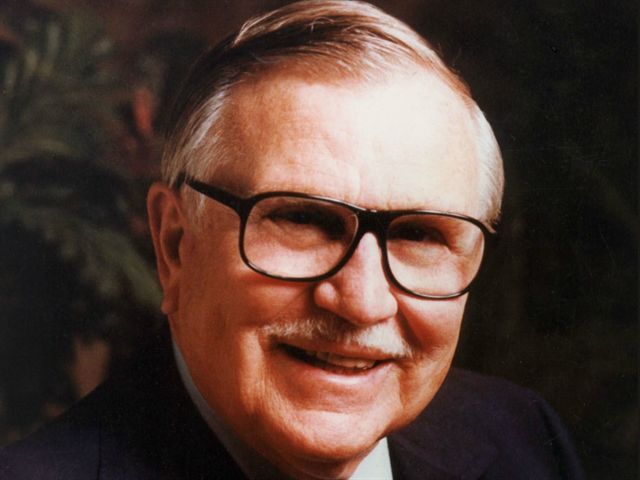
John Vernon McGeewas born in Hillsboro, Texas, in 1904. Dr. McGee remarked, "When I was born and the doctor gave me the customary whack, my mother said that I let out a yell that could be heard on all four borders of Texas!" His Creator well knew that he would need a powerful voice to deliver a powerful message.
After completing his education (including a Th.M. and Th.D. from Dallas Theological Seminary), he and his wife came west, settling in Pasadena, California. Dr. McGee's greatest pastorate was at the historic Church of the Open Door in downtown Los Angeles, where he served from 1949 to 1970.
He began teaching Thru the Bible in 1967. After retiring from the pastorate, he set up radio headquarters in Pasadena, and the radio ministry expanded rapidly. Listeners never seem to tire of Dr. J. Vernon McGee's unique brand of rubber-meets-the-road teaching, or his passion for teaching the whole Word of God.
On the morning of December 1, 1988, Dr. McGee fell asleep in his chair and quietly passed into the presence of his Savior.
Contact Thru the Bible with Dr. J. Vernon McGee
Mailing Address
Thru the Bible, Inc.
P.O. Box 7100
Pasadena, CA 91109
In Canada:
Box 25325,
London, Ontario
N6C 6B1
Phone Number
(626) 795-4145 or
(800) 65-BIBLE (24253)