Leviticus 2
Ministries > Thru the Bible with Dr. J. Vernon McGee
https://www.oneplace.com/ministries/thru-the-bible-with-j-vernon-mcgee/
Facebook Twitter Instagram YouTubeLife is about to get sweeter for the children of Israel. The meal offering found in Leviticus 2 represents Christ in His perfect humanity. God calls it “a sweet smelling savor unto the Lord.” This is how God sees Christ and, therefore, how He sees us when we put our faith in Him. That’s pretty sweet!
References
Announcer: How firm a foundation, ye saints of the Lord, is laid for your faith in his excellent word.
Steve Schwetz: The humanity of Jesus. That's what our teacher, Dr. J. Vernon McGee, says we're going to learn about in the Old Testament book of Leviticus, chapter 2. Jesus in Leviticus? A bit surprising, isn't it? Welcome to Thru the Bible. I'm your host, Steve Schwetz, and while you grab your Bible and find your place, let's hear from some friends on the Bible bus. Dr. McGee started our tradition of reading letters on the program, and we love to continue it even today. Hearing what you're learning and how you're passing it along to others really is an encouragement to everyone. Even short letters like this one from David mean so much to us. He says, I have been on the Bible bus since 1992. I use Dr. McGee's teaching to lead a men's Tuesday night Bible study. Keep up the faithful work. I'm praying for your team. Well, thanks, David, and may God bless your Bible study ministry. And then here's another great email. This one's from Martina. I started riding the Bible bus back in 2014. I'm in the middle of my third trip. God is so good. The program is awesome. Like Dr. McGee says, Jesus is on every page. This third trip is different than the first two. God has opened my eyes to understanding the word more deeply with each new five-year program. The Holy Spirit brings out deeper meanings that I hadn't noticed before, like the descendants of Jesus listed in Matthew, going all the way back to Abraham. Until I studied the Old Testament with Dr. McGee, the list of descendants made no sense. Now I see how miraculous Jesus' birth was and how it fulfilled Old Testament prophecy. I feel so blessed to be part of this ministry. God helps me to contribute a little every month to help keep the Bible bus rolling for God's glory. I'm a member of the World Prayer team as well. Keep on doing what you do, and I'll keep riding the Bible bus as long as the Lord lets me. Well, thanks, Martina, both for your enthusiasm and your partnership. I've also found that with each new trip, there's something new and deeper I learn, and we're so glad to have you aboard. Now, what about you? How long have you been on the Bible bus? Are there maybe certain studies that have challenged your thinking? And in turn, are you sharing God's word with others? We want to know that. It really helps us and encourages us. So leave us a note in the app, won't you? You can email [email protected] or write to box 7100, Pasadena, California, 91109. In Canada, box 25325, London, Ontario, N6C 6B1. You can also call and leave a message anytime at 1-800-65-Bible. Now let's pray and get the Bible bus moving. Heavenly Father, help us to see Jesus as we study, and may our love for him grow as we read each word that you've given us. In his precious name, amen. We're off to Leviticus 2 on Thru the Bible with Dr. J. Vernon McGee.
Dr. J. Vernon McGee: Now today, friends, as we come to the second chapter of Leviticus, we're looking at these five offerings that all speak of Christ. The first three offerings speak of the person of Christ, who he is. They're called sweet savor offerings. The last two offerings are non-sweet savor offerings, and they speak of the work of Christ in redemption. Now, we saw last time the burnt offering, and that burnt offering speaks of the person of Christ. And today we come to the meal offering. That speaks of the person of Christ, but in the burnt offering, it was a picture of Christ actually in depth as well as death, but here the humanity of Jesus is revealed in all its perfections and in all of its loveliness. Now, if you'll note that we have here what looks like just a recipe for bread, and you know what it is? That's exactly what it is. It's really the meal offering. It's called a meat offering in our Bibles, but actually no meat was connected with it at all. And there's no shedding of blood, but this offering was different from the others, and it was generally offered with some offering in which there was the shedding of blood. Now the meal or food offering sets forth the humanity of the Lord Jesus and all of his perfections. His deity actually is not in view here. He was perfectly human, and he was the perfect human. You see, God's goal for man is fulfilled in Jesus. He's the second man, but he's the last Adam. There'll be no more Adams, but there are going to be some more men made just like him. Beloved, it doth not yet appear what we shall be, but we know that when he shall appear, we shall be like him. But when you look at mankind today, friends, man as he is in the world today is the most colossal failure in God's universe. Have you ever stopped to think about that? The scriptures are outspoken and specific at this point. They are all gone out of the way, and the original language suggests a wreck. Mankind is a wreck today. All have sinned and come short of the glory of God. My friend, God can't save us by law because we can't render perfection to him. We can't keep it perfectly. And God can't save us by imperfection for the very simple reason that he demands perfection, and that's the best that we can do. And therefore, mankind today is a failure. The way of peace they have not known. The Rockefeller report that came out several years ago shows that man is a warlike creature, and he's that today. Why? Because it's in the human heart. It's rather amusing to hear about these peaceful demonstrations, and they all end up in a brawl, a Donnybrook. Man today, he's trying to perfect some very fiendish instruments of frightful destruction. That's not the goal of man. God has another purpose and another thing in view for man. And if you want to see what he's got in mind, look at Jesus. Here's the man who pleased God. There was a glory in his manhood. The loveliness of Jesus was truly a sweet perfume. His coming was a doxology. His stay was a blessing. His departure was a benediction, and his winsomeness has filled the world with a new hope and an ideal concerning man. Now, there are two important aspects of this offering, and the first is the ingredients that were included, and then second, the ingredients that were specifically excluded, and we want to note that. Now, I've divided the second chapter like this. We have in the first three verses, mixed but unbaked, and then we have verses 4 to 13, mixed and baked, and then we have the first fruits of the ears of corn sprinkled with oil and frankincense. That's verses 14 and 16. Then we go over to the sixth chapter to get the law of the meal offering, and that is chapter 6, verses 14 through 23. Now let's look at this offering. It's very interesting offering to me, and I'm reading verse 1, Leviticus 2. And when any will offer a meal offering unto the Lord, his offering shall be of fine flour, and he shall pour oil upon it and put frankincense thereon. Now, will you notice, first of all, it must be an offering that's made of fine flour. And fine flour in that day was a little unusual. They didn't have these great mills as they have up here at Minneapolis. Actually, they beat it by hand. They put it down in a kind of a rock bowl and used a pestle, I think they call it, and they just tromp it with that, just beat it down. Now, if a person was in a hurry, why, it would be coarse, you see, and uneven. And if it's going to be fine flour, it means it's even, and it means a great deal of time was taken with it. Now, this offering had to be made of very fine flour, which means it was well beaten. Now, I think this sets before us the Lord Jesus in his personality, and today I'm sure the expression would be that he'd be a well-integrated personality. He was a normal person. Actually, I think he's the only normal person that's ever been on this earth. Sin's made all of the race lumpy, one-sided, a lack of being normal. All of us are lumpy. One part of our personality is overdeveloped at the expense of other areas. I studied abnormal psychology in college. In fact, it was my second major, and I assisted the professor of the department for my last year in college. And in this course on abnormal psychology, I went in to see him one day and said, I'd like to talk with you. And he smiled, and he said, go ahead. And he said, I think I know what you're going to say. Well, I said, I don't imagine you do, because I want to say to you that every form of abnormality that we have been studying, when we look at the etiology of the disease, I find I have symptoms of all these forms of abnormality. And he broke out in laughter, and he says, did you know? I was wondering when you would come, because the rest of the class have all been here. They all have it. He said, and I have it too. All of us. I think it's Dr. Menninger over in Kansas that's made the statement that all of mankind today is a little off. We're all just a little off center, and after all, what is normal? Well, that's the way that most of us act, and that's called normality, and that may be way out, friends. That's mankind today. Jesus was the normal person made an even flower. Look at some of the ones in the Bible, how uneven they were. Samson, he was unable to perform great physical feats, but he was weak of both will and mind. In fact, he's a sissy. We'll see that when we get to him. He's one of the biggest sissies in the Bible. And then Paul was a mental giant, but he appeared to be weak in body. And then Simon Peter was moved by his emotions. Even on one occasion he declared he'd die for Jesus, yet he denied him, revealing a definite weakness in the area of the volitional. And you remember King Saul was self-willed and stubborn. He was unable to bow the knee in obedience to God, and this led, by the way, to his dismissal and to his death. All of these men were lumpy. They had over and underdeveloped personalities, and in contrast to them and all of us, Jesus was well balanced. There was an equipoise in all areas of his personality. He could drive the money changes from the temple, but he could take little children in his arms. And when he was 12 years of age, the religious rulers marveled at his wisdom. And when he began to teach, the people were amazed, and they marveled, saying, how knoweth this man letters, having never learned? Nevertheless, the Lord Jesus never appealed to his intellect as the basis for any judgment. Have you ever noticed that? That was never the criterion for his conduct. He came to do the Father's will, and that was the motive for his actions. And Jesus could weep at the tomb of Lazarus or over the indifferent city of Jerusalem, and at the same time, he'd raise Lazarus and pronounced a severe judgment on Jerusalem, which was literally fulfilled. He was not swayed or guided by his emotions. And friends, he was never self-willed, yet nothing could hinder him from going to Jerusalem to die. And at all times he could say, it's not my will, but thine be done. And he could say, I've come to do the Father's will. That was the thing. Then notice something else here. It says that he shall pour oil upon it. Now oil, olive oil speaks of the Holy Spirit. And you'll notice here that it's oil upon the offering. Now if you go down to verses 4 and 5, you'll notice it's with oil, and it's mingled with oil. And then in verse 6, we're told you're to pour oil thereon, that is on the offering. And then in verse 7, it is with oil. Now here you have oil upon it, mingled with oil, pour oil on it, and with oil. In other words, that offering was really drenched with oil, and the oil was a very important part of the offering, and it was applied in many different ways. Now, the prominence of the Holy Spirit in the human life of Jesus, I think's very noticeable. Have you ever noticed he was born of the Spirit? That's mingled with oil. He was baptized of the Spirit, oil upon it. He was led of the Spirit, pour oil thereon. He taught, performed miracles, and offered himself in the power of the Holy Spirit, that's with oil. May I say that if the Lord Jesus Christ, in his perfect humanity, needed the Holy Spirit, what about you and what about me? I think we need him today. We can do nothing of ourselves. Now, there's something else here in this very first verse, frankincense. Now, frankincense was made of a secret formula. It was a form of incense, of course, and it was mixed with incense. We saw that back in the 30th of Exodus, but it was distinguished from it. It was made from some part of a plant or tree, perhaps the bark or the leaves, and it exuded its fragrance only when crushed or beaten or burned or put under pressure. Now this speaks of the life of the Lord Jesus as he manifested the fragrance of his life under the fires of tension and pressures and persecution and even death. Actually, this is what the Father saw in him as the one in whom he delighted. There's a fragrance about his life, and there ought to be that fragrance about our lives also. Now, in verse 2, we're told here he shall bring it to Aaron's sons, the priests, and they shall take there out his handful of the flour, the oil, and all the frankincense thereof, and the priest shall burn the memorial of it upon the altar to be an offering made by fire of a sweet savor unto the Lord. Now the priests received a portion of the meal offering. They were to take out a percentage of each item. Now apparently the remainder was mixed and then burnt upon the altar. And now verse 3, and the remnant of the meal offering shall be Aaron's and his sons. It's a thing most holy of the offerings of the Lord made by fire. Now, we are told here that the offering was to be burnt upon the altar. No blood, though, was shed in connection with it. And great emphasis, you'll notice, that's placed upon fire. And that, I think, is something that's very important to note, because, very frankly, the fire here does not speak in any way of hell at all. And I think we should keep that before us. Now you have from verse 4 down through verse 10 here, that it was mixed and baked, and I'm not going to read all of this. Sounds like a recipe for making bread, and the emphasis upon fine flour and the oil is repeated again and again. Now the fire is mentioned in this section over and over again, and I want to say it with great emphasis. The fire here does not symbolize hell under any circumstance. It is God's purifying energy and power which brought out the sweetness in the life of Christ. And verse 9 specifically says here, it's a sweet savor unto the Lord. It's what God saw in Christ and the sweetness that came out under pressure. Now, sometimes today, sweetness doesn't come out of us under pressure. I've heard some Christians say some very ugly things when they're under tension, but the more tension upon him, the sweeter he was, by the way. And the Lord Jesus made this statement, and he that sent me, he says, is with me. The Father hath not left me alone, for I do always those things that please him. And therefore, believers have the high privilege of sharing Christ, you see, with God the Father. It's what God sees in Christ, but what do you see in him? Is there sweetness about him? Have you smelt the sweetness and the fragrance of his life? That's very, very important to see, by the way. And you remember in John, Jesus said unto them, this is John 6:53, Verily, verily, I say unto you, except ye eat the flesh of the Son of Man, drink his blood, ye have no life in you. Whoso eateth my flesh, drinketh my blood, hath eternal life, and I'll raise him up at the last day. My flesh is meat indeed. And he said his blood was drink, As the living Father sent me, and I live by the Father, so he that eateth me, even he shall live by me. If you want any sweetness in your life, and if I want any, it'll be as you and I actually partake of Christ. Oh, not literally, we're not cannibals. After all, his body's not around today. But what we do, we're doing right now, looking at him, talking about him, and as we partake of him, the sweetness of his life should come into our life. Now, this is a meal offering, a food offering, or a meal offering, and that is what we have offered unto God, by the way. Now, there's another striking feature of this section, and it's constantly repeated. Verse 11 says, no meal offering which ye shall bring unto the Lord shall be made with leaven, for ye shall burn no leaven nor any honey in any offering of the Lord made by fire. Now these are the exclusions. This is what's kept out of the offering. Now leaven, we've already indicated this once. We're going to come to it again and again. Leaven in scripture is everywhere presented as a principle of evil. The Lord Jesus Christ warned his disciples of the leaven of the Pharisees. What was he talking about? He said the doctrine, the teaching of the Pharisees, and that's leaven, evil teaching today. And leaven is a principle of evil. We'll be talking about that again and going into detail about it. Now, leaven is to be kept out. There's no evil in Christ. Which of you convinceth me of sin? Well, there's no sin in his life. And then honey was not to be put in it, and that represents natural sweetness, and it'll sour too. Leaven, you know, is a souring thing. Now, there are Christians today that have a lot of honey in their life. They assume a pious pose in public. They wear a Sunday smile. Butter will not melt in their mouths. They call everyone brother and my dear so-and-so, and their halo is polished with the latest miracle cleanser. Yet these same folks can and do engage in vicious slander and malicious gossip. They're more dangerous than a killer with a gun. Instead of the halo, the horns are prominent. And I know some folk, they have done everything they can to undermine my ministry. They're not but less than a half a dozen. But you know what they say to my face? They say, my, how we love you, brother. Well, I tell you, when I got folk who love me like that, who needs enemies? May I say to you, there are a lot of folk that have honey in their lives. They butter you up. The Lord Jesus, he told it like it was, friends, and that's what we need to do today. Now we're told here in verse 13 that salt shall be put in it. That's the salt of the covenant, still dealt that way over in that land today, the salt of the covenant. And may I say to you, it speaks of faithfulness, and he is faithful. Oh, it said in Revelation, after he'd finished his earthly life
Steve Schwetz: and had moved back into eternity, he's called faithful and true. That's the Lord Jesus. By the way, we ought to be faithful today and found faithful. And we find in the law of the first fruits, again, that every morning with the burnt sacrifice, there was to be a meal offering, that which speaks of the humanity of Christ, for he offered himself and his body for your sins and mine. Until then, may God richly bless you. He really is faithful. What good, good news that is. If you haven't yet downloaded your free notes and outlines from TTB.org, look for our digital book Briefing the Bible or call us at 1-800-65-BIBLE, and we'll send you an abbreviated paperback copy by mail. Oh, and pro tip, they're available anytime in our app. Another resource that I highly recommend is our Bible companions. Each section includes a clear summary of Dr. McGee's teaching, as well as links to the audio and scripture passages, and then thoughtful reflection questions. Browse the options and download them for free in our app or at TTB.org. Or to purchase paperback versions, shop our online store or call 1-800-65-BIBLE. And when you're in touch, why don't you tell us how you listen to Thru the Bible? This little bit of information is a huge help as we follow God's leading and taking his whole word to the whole world. So thanks in advance for your help. Now, as we go, I want to encourage you to read ahead through Leviticus chapter 3 this time, which tells us about the peace offering and how it applies to our lives even now. If you want to always be prepared and read ahead in every study, which I always think is a great idea, you're going to want our bookmark reading guide. You can download it in our app or online at ttb.org, but I love getting the physical bookmark every month along with the ministry newsletter. I keep it right in my Bible, and it makes keeping up with the Bible bus super easy. To subscribe to our mailing list, just go to ttb.org or give us a call. Our phone number again is 1-800-65-BIBLE. I'm Steve Schwetz, praying that God blesses and keeps you until we gather around his word next time. To be my own. Sin had left a crimson stain, be washed it white as snow.
Guest (Male): Join us each weekday for our 5-year daily study through the whole Word of God. Check for times on this station or look for Thru the Bible in your favorite podcast store and always at ttb.org.
Related Episodes
Leviticus 1:3-17
Friday, November 13
Leviticus 1:1, 2
Thursday, November 12
Mark 15:38—16:20
Wednesday, November 11
About Thru the Bible
Thru the Bible takes the listener through the entire Bible in just five years, threading back and forth between the Old and New Testaments. You can begin the study at any time. When we have concluded Revelation, we will start over again in Genesis, so if you are with us for five years you will not miss any part of the Bible.
Other Thru the Bible Programs:
Thru the Bible - Minute with McGee
Thru the Bible - Questions & Answers
Thru the Bible - Sunday Sermon
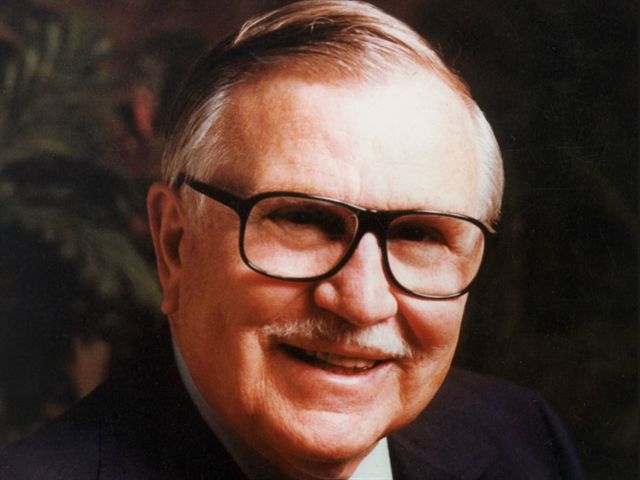
About Dr. J. Vernon McGee
John Vernon McGeewas born in Hillsboro, Texas, in 1904. Dr. McGee remarked, "When I was born and the doctor gave me the customary whack, my mother said that I let out a yell that could be heard on all four borders of Texas!" His Creator well knew that he would need a powerful voice to deliver a powerful message.
After completing his education (including a Th.M. and Th.D. from Dallas Theological Seminary), he and his wife came west, settling in Pasadena, California. Dr. McGee's greatest pastorate was at the historic Church of the Open Door in downtown Los Angeles, where he served from 1949 to 1970.
He began teaching Thru the Bible in 1967. After retiring from the pastorate, he set up radio headquarters in Pasadena, and the radio ministry expanded rapidly. Listeners never seem to tire of Dr. J. Vernon McGee's unique brand of rubber-meets-the-road teaching, or his passion for teaching the whole Word of God.
On the morning of December 1, 1988, Dr. McGee fell asleep in his chair and quietly passed into the presence of his Savior.
Contact Thru the Bible with Dr. J. Vernon McGee
Mailing Address
Thru the Bible, Inc.
P.O. Box 7100
Pasadena, CA 91109
In Canada:
Box 25325,
London, Ontario
N6C 6B1
Phone Number
(626) 795-4145 or
(800) 65-BIBLE (24253)