Matthew 26:23-75
Ministries > Thru the Bible with Dr. J. Vernon McGee
https://www.oneplace.com/ministries/thru-the-bible-with-j-vernon-mcgee/
Facebook Twitter Instagram YouTubeWas Jesus ever tempted to quit—return to heaven and ask the Father to find another way to save us? He was tested in the wilderness in the beginning of His ministry, now Jesus was tested in the Garden of Gethsemane just as He was ready to give His life on the cross. Visit with Him there.
References
Steve: Was Jesus ever tempted to quit? Maybe you remember when we studied how Satan tempted Jesus in the wilderness early in his ministry. Well, in our study of Matthew 26, we're going to see that Jesus' greatest temptation came at the end of his ministry, just as he was about to give his life on the cross. This is Through the Bible with Dr. J. Vernon McGee, and I'm Steve Schwetz. And as you find your seat on the Bible bus, Greg and I have got time for a letter in response to our home group ministry.
Greg: Yeah, we're going all the way up into the northernmost state of India, called Himachal Pradesh. And this this letter we're going to read from is a smaller language.
Steve: Yeah. It's called Mandali.
Greg: Yeah, and I I'd never heard of it, to be honest. And we're just so excited that our South Asian leaders and particularly the team in India said, this is a group of people we want to reach. They're saying around 600 to 650,000. So,
Steve: Yeah. That's a lot of people we want to reach.
Greg: Absolutely.
Steve: And there's not a lot of content in their language. And we've talked about that. That's that's our strategy with going with these radio home groups is, let's get into these smaller languages and let's see, a fishing term, let's chum the waters and see what kind of response we get.
Greg: Yes. Right.
Steve: And so it's a subset of Dr. McGee's teaching, not truncated, but only six books of the Bible. And we go through that systematically, just like you do in the long-form content, and the response that we're getting and the people that are responding, it's just such an encouragement. It's another way that the Lord has opened a completely new door of ministry for us, really, using the same program through the Bible.
Greg: Yes. And another, to change the metaphor, we're also priming the pump. In other words, we're testing the leaders in that area because we've already seen some leaders say, look, you gave us the scriptures, you gave us recording equipment, you trained us. We did six books. We'll do the other 60 ourselves. And that's what we're hoping for.
Steve: Yeah. Let's get to this letter which is from Ria. And it is so encouraging to me for, and I'll I'll point it out along the way. She writes, "There was no peace in our family. My parents did not know much about God and there were frequent quarrels at home. My father was a heavy drinker, and whenever he came home after drinking, the atmosphere of our house would be completely disturbed. But God has brought a great change in our lives. One day, I had the opportunity to join a radio home group and began learning the word of God regularly. Slowly, I encouraged my parents to listen and join as well. Through this, a wonderful change took place in our family. My father stopped drinking alcohol and the quarreling between my parents came to an end. Now there is peace in our home. Every night before going to sleep, all of us gather together to pray and read the Bible. I'm very thankful to your ministry for providing Bible study materials in our Mandali language because of this, the language barrier was removed and we are able to understand the word of God more clearly and experience God's blessings in our lives."
Greg: Yeah, I love it when our listeners say it better than we could say it ourselves. This this person just said that by the grace of God and through our partners, through the Bible removed the language barrier. And there's 600 plus thousand people that have probably never heard systematic Bible teaching.
Steve: Yeah.
Greg: And by God's grace, it's happening.
Steve: Yeah, and the encouraging thing in this letter, there's so many things in there, but she said, "Every night before going to sleep, all of us gather together to pray and read the Bible." And that's, yeah, Through the Bible is a part of their their life now, but the Bible is a part of their life.
Greg: Exactly.
Steve: And that's the direct connection.
Greg: Exactly.
Steve: Greg, pray for us as we begin our study.
Greg: Father, once again, we bow before you, acknowledging the wonderful things you're doing to reach people with your word and the gratitude that we have that we get to play a small part in your transformation of people's lives. We pray that it would continue to happen in hundreds of languages and in thousands of places around the world today, in Jesus' name. Amen.
Steve: Here's our study of Matthew 26 on Through the Bible with Dr. J. Vernon McGee.
Dr. J. Vernon McGee: Back to the 26th chapter of the Gospel of Matthew today. If you have your Bible, turn to Matthew 26 and verse 23. We're going to conclude this chapter today, I hope. Now, we are in this section that has to do with the events immediately preceding the cross of Christ. These are the final events in his life before he died for your sins and my sins. We saw first of all, that he told his own that he'd come now to Jerusalem to die, and he set the time of his death during the Passover. The enemy has determined he's going to die also and they set the time of his death, which would be after the Passover. They were wrong. He died at the time he set. He's in charge, he's the king, after all. And then you have this lovely thing that took place out at Bethphage, home of Simon the leper. That's where Jesus was at home. That's where he stayed in people's homes. He never seemed to want to spend time in Jerusalem, and yet that was the city of the great King, but they had rejected him. And out there, Judas Iscariot led the disciples and opposing that waste of ointment, but our Lord said she's the only one that knew what she was doing. She poured it on him in view of the fact that he was to die for the sins of the world. Then we have this very dark event of the betrayal of Judas, that is, of his arrangement and plot to betray the Lord Jesus, and we'll see he'll carry out his nefarious act in this chapter here. Now, he went with his own into the upper room, and there in the upper room, why, he made the announcement that one would betray him. They all felt that they could do it. They were all capable. I'd betray him in the next five minutes if he didn't keep his hand on me. And that ought to keep me close to him. It should keep you close to him. Now I begin reading at verse 23 because each one said, "Lord, is it I?" And now he answered and said, "He that dippeth his hand with me in the dish, the same shall betray me. The Son of Man goeth as it is written of him, but woe unto that man by whom the Son of Man is betrayed. It had been good for that man if he had not been born." Some people say that you ought not to keep children from being born into this world. Well, here's one man that shouldn't have been born, friends. Verse 25, "Then Judas, which betrayed him, answered and said, 'Master, is it I?'" He didn't say, "Lord." He couldn't call him "Lord." He could only call him "Master." "He said unto him, 'Thou hast said.'" And at this point, apparently, Judas left the room. John goes into more detail at this point and explains that he left at this time. Verse 26, "And as they were eating, Jesus took bread and blessed it, and brake it, and gave it to the disciples, and said, 'Take, eat; this is my body.' Took the cup, gave thanks, and gave it to them, saying, 'Drink ye all of it; for this is my blood of the new testament, which is shed for many for the remission of sins.'" You see, we have here instituting the Lord's Supper over the dying ashes of a fading feast, the Passover. He makes it very clear, "But I say unto you, I'll not drink henceforth of this fruit of the vine until that day when I drink it new with you in my Father's kingdom." Passover's to be reinstituted in the millennium. He says here that he'll drink the fruit of the vine again in the kingdom. That means that the Passover, apparently, will then look back to his death as the Lord's Supper, which he's instituted here, looks back to his death for you and me today in the church. But the Passover, which had looked forward to his coming, will also look back to his coming in the kingdom. We are told, "When they had sung a hymn, they went out unto the Mount of Olives." Now, this ends the first division of this chapter. It seems to me now we have a new division. Verse 31, "Then said Jesus unto them, 'All ye shall be offended because of me this night: for it's written, I'll smite the shepherd, and the sheep of the flock shall be scattered abroad. But after I'm risen again, I'll go before you into Galilee.'" "Peter answered and said unto him, 'Though all men shall be offended because of thee, yet will I never be offended.'" This man he just same as saying that he didn't trust the other apostles himself, but that the Lord could surely depend on him. But his problem was, he didn't know himself. And that's the problem many of us have today. We really do not know ourselves. "Jesus said unto him, 'Verily I say unto thee, that this night, before the cock crow, thou shalt deny me thrice.'" And Peter said unto him, "Though I should die with thee, yet will I not deny thee.' Likewise also said all the disciples." This man said that he would not betray Christ, but our Lord said that very night before the cock would crow, three times he would deny him, not just once, but three times. That is, before morning. And that was the night that Simon Peter, of course, did betray him. We'll have an occasion to go into that later. Now, let's move on. "Then cometh Jesus with them into a place called Gethsemane, and saith unto his disciples, 'Sit ye here, while I go and pray yonder.' And he took with him Peter and the two sons of Zebedee, and began to be sorrowful and very heavy. Then saith he unto them, 'My soul is exceeding sorrowful, even unto death: tarry ye here, and watch with me.' And he went a little farther, and fell on his face, and prayed, saying, 'O my Father, if it be possible, let this cup pass from me: nevertheless not as I will, but as thou wilt.'" I want to go into the Garden of Gethsemane in a great deal more detail in another one of the gospels. Here the thing that we need to pay attention to is this, that these three men now that he takes with him, come with him into the garden. And the prayer that he's praying here, when he prays that the cup might pass from him in his humanity, the horror of that death that he was to die. And I think actually, more than the death itself, and something that we do not realize, or at least we don't seem to emphasize today, that he was made sin for us. Now, he was holy, harmless, undefiled, separate from sinners, but there on the cross the sins put on him, not in some forensic or academic manner, but in reality, the sins put on him. And when that sin was put on him, why, he at that very moment with horror. It was a horrendous thing that he experienced when this one who is holy as he is, is made sin for us. And so it's difficult for you and me to enter into the full significance of Gethsemane. But I believe here is where he won the victory at Calvary. The cup was evidently his cross, and the contents were the sins of the whole world. These were repugnant to his holy character. He's not asking to escape the cross, but he's praying for God's will to be done. And this, I do not think by any means exhausts the meaning of Gethsemane. He was tempted by Satan. I think as truly in Gethsemane as he was in the wilderness. But that's the prayer now that he makes here in the garden. Now, we'll have occasion to go into this in actually more detail when we get to the Gospel of Luke. I'm reading now verse 42. "He went away again the second time, and prayed, saying, 'O my Father, if this cup may not pass away from me, except I drink it, thy will be done.'" He is accepting it. Those today that say that he's trying to avoid going to the cross is not exactly true. This is the repugnance and the awful horror of his humanity against the drinking of the cup, which means having the sins of the world put upon him there upon the cross. These men, they went to sleep. He came and found them asleep again, for their eyes were heavy. He left them and went away again, and prayed the third time, saying the same words. "Then cometh he to his disciples, and saith unto them, 'Sleep on now, take your rest: behold, the hour is at hand, and the Son of Man is betrayed into the hands of sinners.'" And I think that a space of time takes place here. There's an interval. I do not know how long. He told them to sleep on, and the next verse says, "Rise, let us go." Obviously, he didn't say, "Let's sleep" and now immediately say, "Let's get up." What you have is an interval here, and they had their nap, as it were. They needed this rest. You notice how he pays attention to the needs of their bodies. These men needed that rest. And he says now, after they've rested a while, "Rise, let us be going: behold, he is at hand that doth betray me." "And while he yet spake, lo, Judas, one of the twelve, came, and with him a great multitude with swords and staves, from the chief priests and elders of the people." The fact that Judas and the enemy had witnessed many miracles, they did realize that he had supernatural power and that he might use that. And so they bring as many out to take him as possible. I think the whole guard that was in Jerusalem at this time. And Pilate always brought up a big guard to Jerusalem. He didn't like Jerusalem. He stayed over at Caesarea. And he would only come in to Jerusalem on the feast days, and he brought a guard in order to keep order because there were generally riots at this time. "And while he yet spake, lo, Judas, one of the twelve, came, with him a great multitude with swords and staves, from the chief priests and elders of the people. Now he that betrayed him gave them a sign, saying, 'Whomsoever I shall kiss, that same is he: hold him fast.'" That hot kiss of betrayal is one of the worst things any man's ever done. "And forthwith he came to Jesus, and said, 'Hail, Master;' and kissed him. And Jesus said unto him, 'Friend, wherefore art thou come?' Then came they and laid hands on Jesus, and took him." Now, the theologians today, they argue about whether this man Judas was predestined to betray Jesus and he couldn't do anything else. Well, if that is true, of course, and he couldn't do anything else, then he was nothing in the world but a robot. But I think he made up his own mind and that he had every opportunity not to do it. But somebody said, "Yes, but it's prophesied that he was to do it." Is that right? Well, I'll have to agree with you. It is right. It is prophesied. And our Lord's marked him out, he's the man. Now, could he have changed that? Oh, yes. After he came here and betrayed the Lord Jesus, I won't argue with anyone about whether he's predestined and all that type of thing and it's prophesied and he could do nothing about it. He can do something about it now, after he has fulfilled the prophecy. After Jesus is betrayed, the Lord Jesus could still call him friend. And he said here, after he's betrayed him, after he's marked Jesus out with that hot kiss of betrayal, "Friend." Still calls him friend, "Wherefore art thou come?" In other words, he's saying to Judas, "Judas, you can turn this hot kiss of betrayal into a kiss of acceptance, of repentance, of coming back to me." And then a little later, when he came into the temple and threw the pieces of silver down that had been given to him. He at that time, when the priests were going through, they were leading Jesus then over to Pilate. He could have fallen down before the Lord Jesus and said, "Forgive me. Forgive me. I didn't know what I was doing." Would he have been forgiven? He certainly would have. I won't argue about being predestinated and it's prophesied. All I know is, I'm just a poor preacher, that after he did it, that he could have accepted Christ. He could have turned to him. It was quite possible. Our Lord gave him that opportunity here. Now, verse 51, "And behold, one of them which were with Jesus stretched out his hand, and drew his sword, and struck a servant of the high priest's, and smote off his ear." You know who that was, don't you? It was Simon Peter. You know what he's doing? He's trying to prove something. This man has been told that he's going to deny the Lord Jesus that night. Well, he got a sword somewhere and he says he's going to protect him and he tried to do it. We're told he cut off an ear. Now, this man's a fisherman. He's no swordsman. He wasn't after ears, he was after his head. He'd love to lob off the man's head. Be sure, almost missed him. "Then said Jesus unto him, 'Put up again thy sword into its place: for all they that take the sword shall perish with the sword. Thinkest thou that I cannot now pray to my Father, and he shall presently give me more than twelve legions of angels?'" I don't need your little sword, Simon Peter. I haven't come to put up a battle against the religious rulers. I've come to die for the sins of the world. Simon Peter missed it at this moment, of course. Verse 54, "But how then shall the scripture be fulfilled, that thus it must be?" You see, our Lord is fulfilling scripture, and he makes that clear in Matthew. Verse 55, "In that same hour said Jesus to the multitudes, 'Are ye come out as against a thief with swords and staves for to take me? I sat daily with you teaching in the temple, and ye laid no hold on me.'" You see, his hour had not come. Now it has come. Verse 56, "Listen to him, 'But all this was done, that the scriptures of the prophets might be fulfilled.' Then all the disciples forsook him, and fled." He'd predicted that. They leave him now. Now we come to the third division of this chapter, chapter 26 of Matthew. Now, will you notice, "And they that laid hold on Jesus led him away to Caiaphas, the high priest, where the scribes and the elders were assembled." And we find out later on that the father-in-law of Caiaphas was really the one that instigated all of this. I'll go into that when we get to the Gospel of John. But here, he's brought now to Caiaphas. He was the high priest, and he must be brought there for the first charge. You see, they've got to determine that night, because they're going to ask for the death penalty, just what it'll be when they go to Pilate. Now, we are told verse 58, "But Peter followed him afar off unto the high priest's palace, and went in, and sat with the servants, to see the end." Simon Peter followed afar off. Verse 59, "Now the chief priests and elders, and all the council sought false witness against Jesus to put him to death; but found none. Yea, though many false witnesses came, yet found they none. At the last came two false witnesses." You see the problem in getting a false witness is getting a witness that'll stand up under court investigation. After all, Pilate might be a little inquisitive, which he was, and ask a few knowing questions. Now, they finally found two witnesses that said, "This fellow said, 'I'm able to destroy the temple of God and to build it in three days.'" Now, you see that the disciples misunderstood that statement. John tells us that. And this man was present at that time, and he said, "I heard him say that." The high priest rose and said unto him, "Answerest thou nothing? What is it which these witness against thee?" Now, he tries to get the Lord Jesus to answer so they'll know what kind of argument to put up. But Jesus held his peace. He had nothing to say to the high priest relative to this. It's so absolutely far-fetched. "And the high priest answered and said unto him, 'I adjure thee by the living God, that thou tell us whether thou be the Christ, the Son of God.'" Now, the high priest puts him on oath, and he asks him the specific question, "Are you the Christ, the Son of God?" "Jesus said unto him, 'Thou hast said.'" And that's tantamount to saying, "Yes, I am." "Thou hast said." That's right, "I am." "You said it. That's who I am. Nevertheless, I say unto you, Hereafter shall you see the Son of Man sitting on the right hand of power and coming in the clouds of heaven." Now, the title he claims for himself here is "Son of Man." As Dr. Warfield says, that's the highest title that he had. That "Son of Man" goes back to the book of Daniel. The prophets used this. Ezekiel used it, and it is a title of deity. He could have claimed no greater title than to have said that he's the Son of Man sitting on the right hand of power and coming in the clouds of heaven. "Then the high priest ran his clothes," and it was against the Mosaic law for the high priest to run his clothes, "saying, 'He hath spoken blasphemy; what further need have we of witnesses? Behold, now we've heard his blasphemy.' Now they think they have something. 'What think ye?' They answered and said, 'He's guilty of death.' Then did they spit in his face, and buffeted him; and other smote him with the palms of their hands." How they hated him. Hating the Lord Jesus. You see, this is the natural antagonism of the human heart to his goodness, his righteousness, his holiness, and the fact that he's God. Did you know, friends, if you and I, that if we had our way with just that old nature, we'd knock God off of his throne? That's the reason the crowd went around and said, "God's dead." Why would they say that? Because they'd like to get him off his throne. Human nature hates him. They spat on him, they buffeted him, they smote him with the palms of their hands and ridiculed him, saying, "Prophesy unto us, thou Christ, who is he that smote thee?" And they played a game with him. I'll talk about that when we get the Gospel of Mark. It was hot hand. They would blindfold him, hit him in the face, then he'd have to guess who hit him. He never guessed, of course. They never would let him. "Now Peter sat without in the palace: and a damsel came unto him, saying, 'Thou also wast with Jesus of Galilee.' He denied before them." And I'm going into this in a great deal of detail later. Verse 73, "After a while came another unto him, and stood by, and said to Peter, 'Surely thou also art one of them; for thy speech betrayeth thee.' Then began he to curse and to swear," and he could do that, by the way. "I know not the man.' And immediately the cock crew. And Peter remembered the words of Jesus, which said unto him, Before the cock crow, thou shalt deny me thrice.' He went out, and wept bitterly." This poor man didn't realize how weak he really was, but our Lord had prayed that his faith fail not. And he could repent and come back and he did. Judas could have. Now, chapter 27, we'll see the death, the crucifixion of Christ, after the trial. Until next time, may God richly bless you, my beloved.
Steve: Well, in our next study, we follow Jesus' journey to the cross as the Bible bus pulls up to Matthew 27. Until then, to be in touch, send a note through our app or email Bible bus at TTB.org, or call 1-800-65 Bible. Through the Bible exists to take God's whole word to the whole world, and we invite you to stand with us with your faithful prayer and financial support. Where will God's word go today?
Related Episodes
Matthew 25:31—26:22
Friday, August 21
Matthew 24:32—25:30
Thursday, August 20
Matthew 24:14-32
Wednesday, August 19
About Thru the Bible
Thru the Bible takes the listener through the entire Bible in just five years, threading back and forth between the Old and New Testaments. You can begin the study at any time. When we have concluded Revelation, we will start over again in Genesis, so if you are with us for five years you will not miss any part of the Bible.
Other Thru the Bible Programs:
Thru the Bible - Minute with McGee
Thru the Bible - Questions & Answers
Thru the Bible - Sunday Sermon
About Dr. J. Vernon McGee
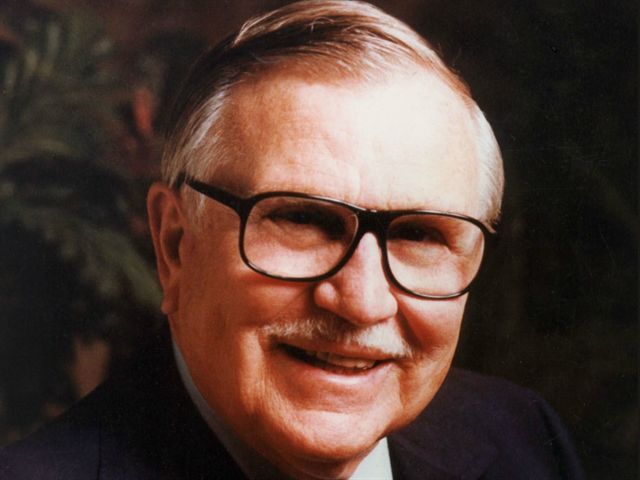
John Vernon McGeewas born in Hillsboro, Texas, in 1904. Dr. McGee remarked, "When I was born and the doctor gave me the customary whack, my mother said that I let out a yell that could be heard on all four borders of Texas!" His Creator well knew that he would need a powerful voice to deliver a powerful message.
After completing his education (including a Th.M. and Th.D. from Dallas Theological Seminary), he and his wife came west, settling in Pasadena, California. Dr. McGee's greatest pastorate was at the historic Church of the Open Door in downtown Los Angeles, where he served from 1949 to 1970.
He began teaching Thru the Bible in 1967. After retiring from the pastorate, he set up radio headquarters in Pasadena, and the radio ministry expanded rapidly. Listeners never seem to tire of Dr. J. Vernon McGee's unique brand of rubber-meets-the-road teaching, or his passion for teaching the whole Word of God.
On the morning of December 1, 1988, Dr. McGee fell asleep in his chair and quietly passed into the presence of his Savior.
Contact Thru the Bible with Dr. J. Vernon McGee
Mailing Address
Thru the Bible, Inc.
P.O. Box 7100
Pasadena, CA 91109
In Canada:
Box 25325,
London, Ontario
N6C 6B1
Phone Number
(626) 795-4145 or
(800) 65-BIBLE (24253)